Honors
- “People in Elevators” won a Pushcart Prize (Pushcart Prize Volume LI)
- “The Long Game” selected for Best Microfiction 2026
- “Buckets” long-listed for SmokelongQuarterly‘s Workshop Prize 2025
- “Counting,” “Stupid Motorist Law,” “Pinch Hitter,” and “Useful Skills” all made the Wigleaf Top 50 longlist for 2024
- “Counting” selected for Best Microfiction 2024
- “Pinch Hitter” won The Sunlight Press 2023 flash fiction contest
- “Fake Fruit” made the Wigleaf top 50 longlist for 2023
- “My Sister’s Monkey” was selected for inclusion in Best Small Fictions 2023, as well as chosen as one of ten spotlighted stories for the anthology
- “Squash” and “What I Owned” were selected for inclusion in Best Microfiction 2023
- Special Mention, 2023 Pushcart Prize anthology, for “Paula Watt,” published in Witness
- “Costs” was selected for the 2022 Wigleaf Top 50
- Shapeshifting has a Rave review on Lit Hub‘s BookMarks
- “The Pregnancy Game” was selected for inclusion in Flash Fiction America (Norton 2023)
- Won the 2021 Katherine Anne Porter Prize in Short Fiction
- “Hostages” was long-listed for the 2021 Wigleaf Top 50
- “Hand-Me-Downs” won the 2021 Zizzle Literary Flash Fiction contest
- “Cake or Pie” was selected for Best Small Fictions 2021
- “Keeper Four” won the 2020 Sue Lile Inman Fiction Prize, Emrys Journal
- “Mirrors” was selected for Best Microfiction 2021
- Winner of 2020 Stillhouse Books Short Story Award
- “Fertilizer” and “Manhandle” were long-listed for the 2020 Wigleaf Top 50
- “Fertilizer” and “Palate Cleanser” were selected for Best Microfiction 2020
- Electric Literature included my story “If My Mother Was the Final Girl” on this list of Our Favorite Essays and Stories About Horror Films
- “One or Two?” selected for 2019 Wigleaf Top 50; also, “An Arm or a Palm Frond or a Boot” was long-listed
- Entropy included my story “Night Bloom,” published in The Forge, in their list of the best online short stories of 2018
- Finalist, 2018 Best of the Net Anthology for “Why Science Lessons That Involve Potatoes Give Me Grief”
- Finalist, 2017 Foreward INDIES Book of the Year Awards in Short Stories
- Paper Darts included There’s So Much They Haven’t Told Youon their list of favorite small press story collections of 2017
- Long-listed for 2017 Wigleaf Top 50 for “Phainopepla”
- Winner of 2016 Moon City Press Short Fiction Award
- Runner-up for 2016 Juniper Prize in Short Fiction
- 3rd Place Winner, Sixfold 2016 Spring Fiction Contest for “An Impromptu Lesson on Black Holes”
- 3rd Place Winner, Sixfold 2015 Winter Fiction Contest for “Waiting for the Cottonmouths to Feed”
- Winner of Sixfold 2014 Winter Fiction Contest for “Cinema Verite”
- Winner of Main Street Rag 2005 Fiction Contest for “How Many Ways Can You Die on a Bus?”
- Winner of Gulf Coast 2002 Fiction Contest for “If My Mother Was the Final Girl”
Interviews
Kim and I talked with Dana Diehl in The Masters Review about our collaboration on Don’t Take This the Wrong Way.
Kim and I talked with Curtis Smith in jmww about our collaboration on Don’t Take This the Wrong Way.
Kim and I talked a bit about our collaborative process for New Flash Fiction Review.
Jamie Thome asked me some questions about writing and editing for Artists Book House.
Luke Rolfes asked me questions about Shapeshifting and They Kept Running for The Laurel Review.
Chuck Augello interviewed me about They Kept Running for the Cease, Cows blog.
Chris Rice Cooper asked me questions about They Kept Running on her blog.
Keith Lesmeister interviewed Kim Magowan and I about our collaborative writing process for Cutleaf.
Ben Woodard interviewed me about They Kept Running for Fiction Writer’s Review.
Kim Magowan and I interviewed each other about our latest books for The Masters Review.
Deborah Kalb asked me some questions about They Kept Running for her blog, Book Q&As with Deborah Kalb.
Lisa Loop asked me some questions about Shapeshifting for The Coachella Review.
I answered a few questions for Apparel for Authors.
Danielle Petty and Harrison McCroskey talked with me about Shapeshifting, interview in Change Seven Magazine.
Yasmina Madden talked with me about Shapeshifting, interview at Necessary Fiction.
Chris Rice Cooper asked me some questions about Shapeshifting, and in particular the story “Life Cycle of an Ungrateful Daughter,” on her blog.
Sara Walker interviewed me about Shapeshifting for the Superstition Review blog
Deborah Kalb interviewed me about Shapeshifting for her blog, Book Q&As with Deborah Kalb.
Kathryn Kulpa interviewed me about Shapeshifting for Cleaver Magazine.
Curtis Smith interviewed me about my new story collection, Shapeshifting, for JMWW,
Al Kratz interviewed Kim Magowan and me about our collaborative story “Twenty-three Safety Manuals,” as well as about the collaboration process in general.
Lilia Shrayfer interviewed me about my story “A Mouth is a House for Teeth” (published in Colorado Review, 2018) for the Center for Literary Publishing blog at Colorado State University.
Sommer Schafer interviewed me about my story “Swarming” for The Forge.
Damyanti Biswas interviewed me on her blog Daily (w)rite.
Cathy Ulrich interviewed me at Pidgeonholes.
Smoke & Mirrors: An Interview with Michelle Ross I talked with Christopher James about my story “The Sand and the Sea” in SmokeLong Quarterly
Tommy Dean interviewed me for his flash fiction interview series.
Valerie Waterhouse interviewed me about my story “Night Bloom” for The Forge.
Dan Wickett asked me a few questions about my story collection for National Short Story Month at Emerging Writers Network.
I was interviewed, along with a number of other flash fiction writers and editors, for this article in The Writer, “Expert Tips for Writing the Best Flash Fiction“
Aram Mrjoian asked me some questions about There’s So Much They Haven’t Told You for The Adroit Journal– A Conversation with Michelle Ross
John Haggerty asked me some questions about writing and about my story “The Difference Between Me and Everyone Else” for The Forge — FLM Author Interview: Sparks Fly with Michelle Ross
Chuck Aguello asked me some questions about There’s So Much They Haven’t Told You for Cease, Cows — Fiction That Multitasks: An Interview with Michelle Ross
Eleanor Gallagher interviewed me for Fiction Writers Review — Learning to Re-See: An Interview with Michelle Ross
Deborah Kalb asked me some questions about my book for Book Q&As with Deborah Kalb — Q&A with Michelle Ross
Smoke and Mirrors: An Interview with Michelle RossI talked with Shane Stricker about my story “Of All the Animals in the Aquarium” in SmokeLong Quarterly
Reviews
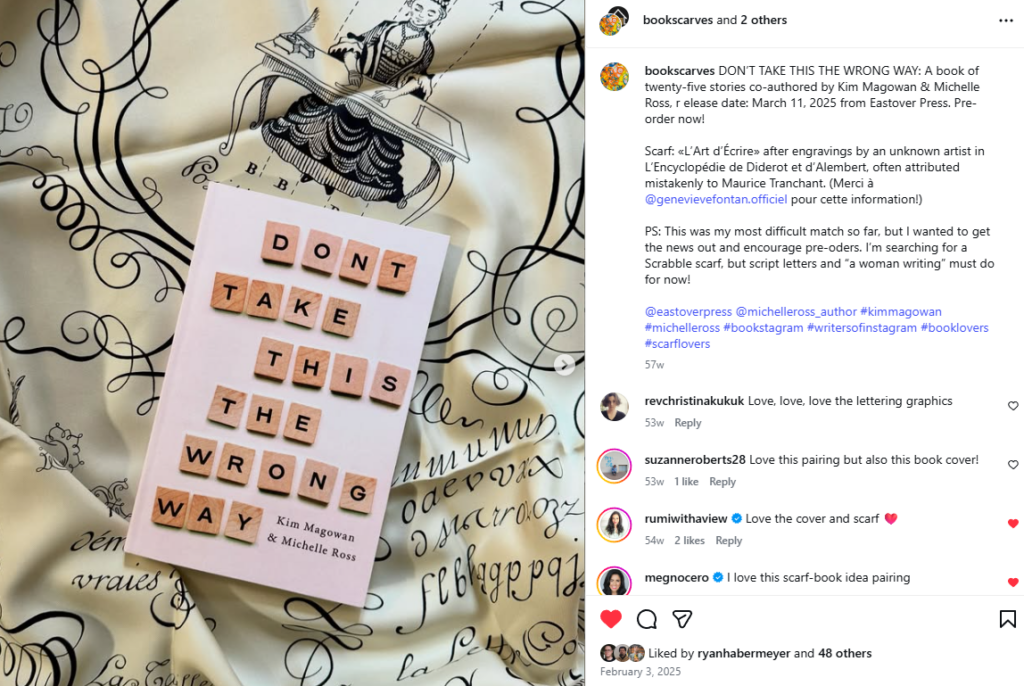
Don’t Take This the Wrong Way
“The first story of this collaborative collection includes two unlikable coworkers. One is so cloyingly upbeat that her emails alternate font colors to resemble rainbows while the other smokes so much that even her emails seem to stink. These characters are emblematic of the people who populate these stories. Most might benefit from a hug but elicit behind-their-back eyerolls instead. Readers are simultaneously absorbed and repulsed (but always fascinated) by their cringelarious dilemmas almost too real for fiction. The authors alternated composing sections as the stories developed, leading to the many unpredictable, powerfully off-balance moments that propel these excellent tales.” — John Sheirer, in Lit Hub’s 100 Notable Small Press Books of 2025
“Because nearly all these stories revolve around characters who struggle to interpret situations and behaviors clearly, they are best read slowly, rather than in quick succession. This is a book that demands some reflection after each story ends, especially given the authors’ interest in their characters’ psychological states… Achingly bittersweet, the stories in Don’t Take This the Wrong Way succeed because they invite us to see our own flaws not as damning, but as ordinary.” — Emily Hall, Heavy Feather Review
““Most of the women at the gym, I can tell by a quick glance I wouldn’t like them,” write Magowan and Ross in one of several mordantly funny openings in this sprightly collection. The range of 25 stories share roughly the same affinities: they are, for the most part, first-person portraits of relationships—between couples, families, friends, and coworkers, many unfolding from female perspectives. The offerings are light on plot, usually jumping around in time, and catch characters in relatively mundane, though revealing, situations, as in “My Coworker Aldona,” where the narrator finds herself trapped in an unpleasant give-and-take with her colleague.
Many of these stories have been published before, but wrangled together they boast a remarkable consistency in style, with deliciously diverse characters: base kids, post-grads, young lovers, middle-aged women. The collection’s opener, “Kindness Woman,” concerns office employees who take umbrage with a newer hire, mostly because she’s overly nice. “Her emails always end with the word, ‘Enjoy!’,” the narrator grouses, “It’s a command.” Another more emotional tale has a woman preparing to euthanize her 20-year-old cat, noting, after giving him extra-fancy food for a final meal, “I wondered if he tasted the difference in price.”
Sharp observations like that are peppered throughout these stories, with cutting lines jumping out around unexpected corners. “There are people who venerate fairness because they have an authentic sense of justice, and then there are people… for whom fairness is an excuse to cudgel everyone into submission,” reflects a sibling in “Oh-Oh-It’s-Cruel,” when navigating tricky family dynamics. Much of the collection retains a cautious optimism that people, ultimately, can rely on each other to get by, just as the young narrator in “War” recounts a budding friendship with dark tones that, in the end, forms a catharsis of sorts for the greater dangers looming from the outside world.” — Publishers Weekly’s Booklife Editor’s Pick
“For some time, I’d been looking forward to reading this forthcoming collection of stories, which were co-authored by Kim Magowan and Michelle Ross. Having finished an advance copy of the collection, I’m delighted to highly recommend it. With dark humor, wit, and a sharp eye for human foibles, the stories explore what makes every kind of human relationship–from the ones we don’t choose to those with siblings, romantic partners, and children–challenging. It also considers why we seek connections nonetheless, and how we try to make meaning from even the messiest and most complicated entanglements.” — Beth Castrodale, Small Press Picks
They Kept Running
“These are difficult stories that prompt difficult thoughts. And yet, they are so delectably constructed and unfolded. They are fairy horror tales, dangerous and bewitching. As one character says in awe of the “Barrel Cactus,” so I would say about the stories in this collection: “I like their armor. Their prickliness makes them beautiful.” — Beret Olsen, 100 Word Story
“Chief among the achievements in They Kept Running is that Ross compels the reader to look closely at the women into whoses lives these awful men–absent fathers, sexual predators, gaslightning morons with fragile egos–enter and asks us to assess the damage they leave behind, physical and emotional, visible and obscured…[These stories] will leave you thinking and feeling at a fever pitchen, then turning back to read them again and again.” — Jeffrey Condran, Moon City Review
“As I read this gem of a book by one of my favorite writers, I was not surprised this collection of flash fictions was chosen for such a distinguished award. This writer deserves this recognition and more. In these stories are women and young girls struggling with love and loss, moments of menace and outright violence, all the while enduring the pitfalls of relationships between parents and siblings, friends and lovers…As a student of craft, I marvel at Ross’s precision on the pages of her award-winning collection. They Kept Running is a singular work of literary fiction and a must-read!” — Dan Crawley, Bending Genres
“There is a laugh-so-you-don’t-cry shade of humor in Ross’s work that makes her razor-sharp observations about how men abuse women easier to take. So when this optometrist touches the narrator’s eyeball (I know–I gasped too) I laughed out loud when she wondered “How do I know he’s not some pervert who gets off on touching people’s eyeballs?” This is something Ross does well throughout the collection–injects a moment of levity into a situation that so accurately depicts what it means to be a woman and lose your voice or be paralyzed by fear. In “Snapshot,” a woman who is driving sees a man on the side of the road with his head in his hands. Later, she tells her husband about it, saying “she’d pictured herself pulling over, knocking on the man’s window, saying something to comfort him […], but what if he’s a misogynist? What if he’s violent?” She tells her husband “[t]hat’s what it is to be a woman in this world. You can’t even empathize with a stranger without thinking about your own safety.” To which her husband replies, “Probably he wasn’t a misogynist.” He completely (and hilariously) misses her point entirely. ” — Frannie McMillan, SmokeLong Quarterly
Shapeshfting
Shapeshifting has a Rave review on Lit Hub‘s BookMarks
“While the process of motherhood for the figures is transformative, it’s never transformative in the way they’d like it to be; rather than making them selfless, perfect mothers to match or fill the inadequacies of the male figures, motherhood strips them of their agency, making them both long for who they were or could have been before while simultaneously guilty for desiring freedom and selfhood…This is truly a collection that devastates us in all the right ways all the way through.” — E. B. Schnepp, Heavy Feather Review
“This book hits hard for those who have struggled with relationships be it with their parents, their children, their spouses or their friends. It asks us to look at ourselves and these relationships past the simple cultural myths surrounding who we are and who we ought to be, and acknowledge are darker thoughts, our more animal impulses, because in us there is, as Ross writes, always a touch of monster DNA. However, if you’re expecting answers as many other “motherhood” books promise, you’ll find none here, at least none that are easy. Ross leaves us questioning and haunted, often closing the stories with beautiful, and painful, elliptical endings that leave the reader often groping for meaning alone just as her characters must. There is no easy moral, or happily ever after stamped onto these stories to give ease and comfort. Rather they often end us with a quick jab, a striking moment or image that lands like a sucker punch, and dulls into an aching throb that will sit with the reader long after they’ve closed the book.” — Couri Johnson, Pumpernickel House
“Although we’re long past the Victorian era, motherhood is still romanticized and idealized in much of the popular culture, and the myth that it’s a “sweet vocation,” and never anything more fraught or complicated, has persisted to a frustrating degree. Michelle Ross’s unflinching and unsparing new book offers a welcome corrective to this myth, tearing it apart and devouring it, story by perceptive story. The honesty of the tales is as refreshing as it is unsettling.” — Beth Castrodale, Small Press Picks
“These poetic lines by Ross enhance the storytelling and her crisp dialogue between characters lets the reader sink into her language. Even in the most uncomfortable moments where dark issues are being discussed, like infertility, male chauvinism, alcoholism, rape and dystopian themes, the lyricism, metaphors and language lull the reader in wanting to move forward despite potential triggers. Ross wants her readers to think and isn’t interested in presenting a glossy panoramic view of motherhood.” — Rudri Patel, Literary Mama
“Ross’s aversion to neat, easy answers is complemented by a gift for dramatizing evidence to the contrary. This is the source of her subtlety. Many of the stories have open, Chekhovian endings. The comfort of resolution is not nearly as interesting as the surprise and mystery arising from observable ambiguity…Ross’s writing probes and tests assumptions that we often take for granted, and raises questions that will leave the reader musing, long after a story is finished.” — Charles Holdefer, Full Stop
“One of the standout stories comes toward the end of the collection, “The Pregnancy Game,” the only story to not prominently feature a mother figure or mother-to-be. In it, a group of girls play a game in the woods, organized by one of their number. They are given a status (pregnant or not pregnant), roll a die, and then advance forward a number of spaces and read their fate off a paper plate, options such as “You’re a slut who had casual sex and then took a morning-after pill. Go back to start.” The participating girls are confused; there’s no good outcome, pregnant or not. It is a brief but hard story, one about loss and the backwards laws women are still fighting against in this country. Consequently, it is the story that best captures womanhood: these are girls just entering the seventh grade, and already they are grappling with the consequences of pregnancy, Right to Life activists, late-term loss, their sexuality and gender and what these mean. Already, they are learning what rights and freedoms they and their bodies don’t have.” — Kathryn Ordiway, Masters Review
“The writing throughout this collection is compelling; the dialogue is especially authentic. But what really propels this group of stories is that Ross’s characters invite us into their most vulnerable moments and confess the kinds of imperfections that keep plenty of mothers awake at night. Ultimately, as one narrator reminds us: “all children are experiments — messy, uncontrolled, long-term experiments. Every day, there’s more to observe and discover.” And so it follows that every day, there is so much more we mothers are hoping to get right.” — Carla Panciera, Mom Egg Review
“Ross’s writing is descriptive and still manages to be spartan; the characters are complex and occupy their pain to a degree that’s magnetic and disturbing. Each interaction is a ten-car pileup you can’t help but watch. Each piece of dialogue and exposition rolls into the next, exquisite and excruciatingly beautiful.” — Mick Parsons, Moon City Review
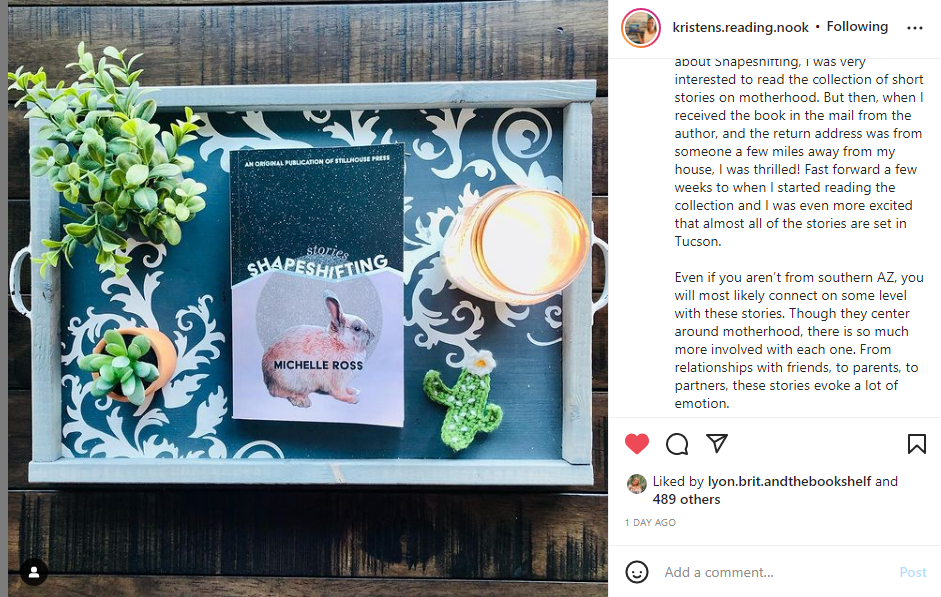
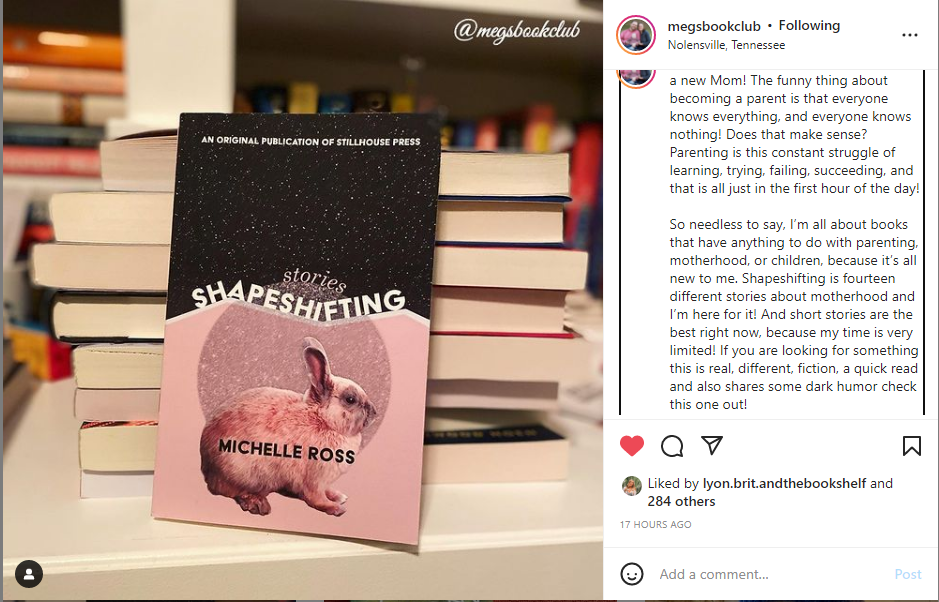
“I had an opportunity to get my hands on this very special collection of short stories from author Michelle N Ross called Shapeshifting. It is a collection of fourteen stories that I intentionally slowly read in the course of a week, ensuring I don’t devour this in one sitting – which I certainly could have had, but this was meant to be savored. It was a book I was tickled to read as I wound down into the evening with a cup of tea, and on some nights indulging with a glass of wine – which was absolutely perfect to match with these ever so feminist stories about motherhood – the trying and failing, and sometimes accidentally succeeding. Within the stories were pieces of me and Ross really understood the human existence. Motherhood and being a woman was front center in these stories.
Ross is incredibly funny and brilliant, and the writing is incredible!” —@nurse_bookie
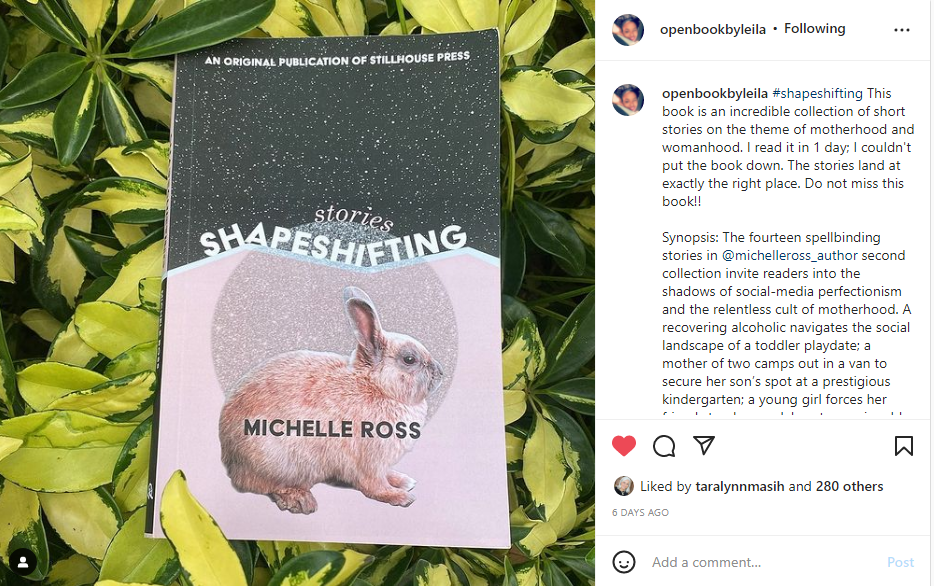
“Michelle Ross has a sly sense of humor and a wry imagination. I really enjoyed this collection of stories. It’s the sort of book to read and re-read, and loan out to your friends. Highly recommended.” — 5 Minute for Mom:
“The stories are smart and funny or sad or thoughtful, depending on how you view the characters. As a mom who is currently researching how to get my toddler into some of those prestigious programs that may be free if you’re only willing to sacrifice a (identify treasured limb here), these characters touch me and motivate me and make me wish I knew them in real life. The title of the collection feels appropriate for the varied identities the women must take on in each story as they relate to their spouses, friends and people who act like friends but are really the thorns in their sides, their children, their own parents. The women are all strong even when they could use some real support themselves. Definitely read this one if you want to know what it’s like when feminists become mothers, or if you’re not a mother and want the behind-the-scenes look at the sacrifices that accompany the joys of motherhood.” — Run Wright
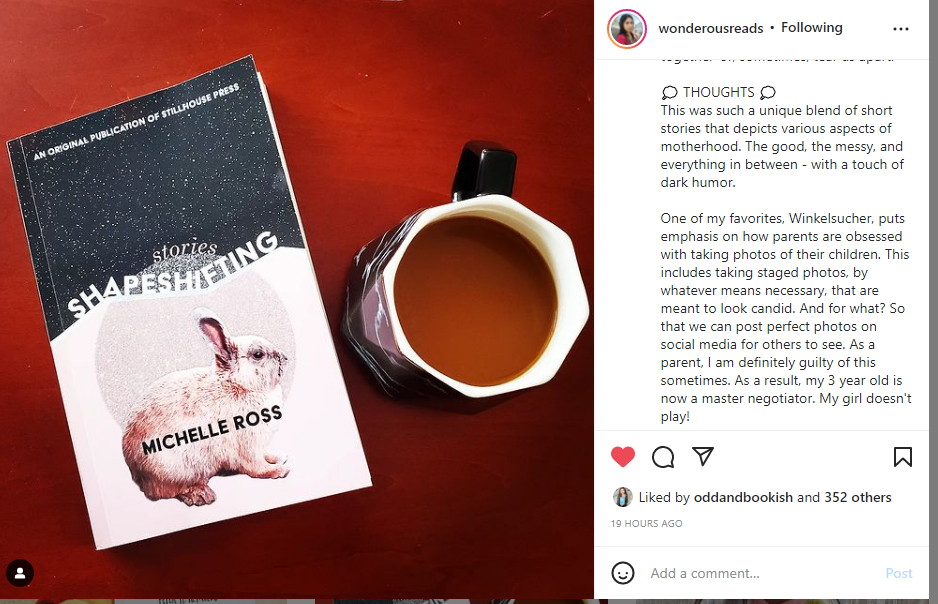
“I really appreciated how well Ross was able to convey the various traumas and feelings that surround being a mother, becoming a mother, and the ways in which the world around us perceives mothers and motherhood, from all different angles and world views. This collection is at times frightening, hilarious, sobering, tragic, and enlightening, and I found it exceptionally difficult to put down at many different points while reading it.” — Forever Lost in Literature
“Shapeshifting is a poignant collection of short stories that are authentic, powerful, and relatable…Ross also explores the enormous weight of maternal guilt, and how easily we connect our child’s struggles to something we did or failed to do. Shapeshifting illustrates that all families struggle in some way, and all mothers are flawed. Parenting is not neat and tidy because people are messy and complicated. Ross takes us through the blood, sweat and tears of parenting; experiencing the most intense kind of love, but also anxiety and sleepless nights filled with raw emotion. Ross demonstrates how parenthood brings to the surface everything about ourselves that we might have preferred to keep buried. We work so hard to shield our children from our most shameful parts, but these problems still manage to fall right into their laps anyway. Well-written, intriguing, and emotional, Shapeshifting is a book that I highly recommend to all mothers. Bravo!” — The Cozy Book Blog
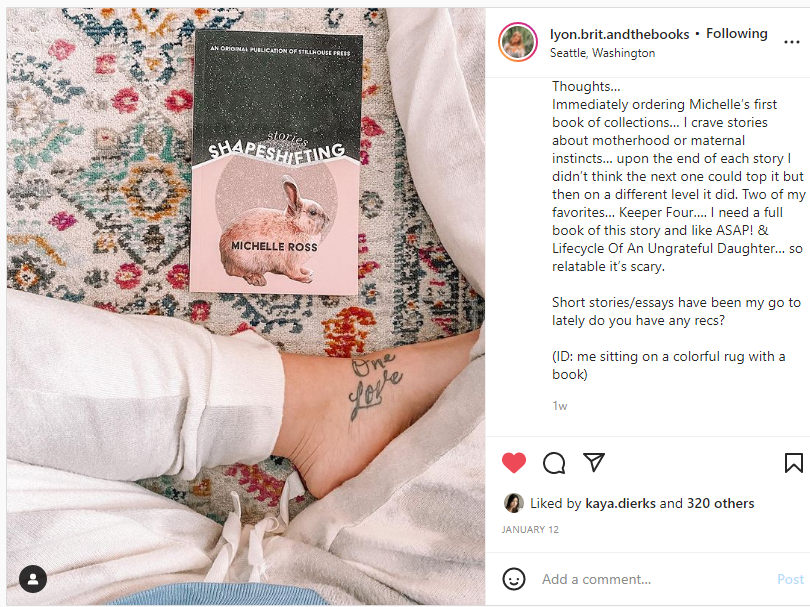
“As a mother, I was very curious about this book. Fourteen stories about motherhood and the different ways they shape us. I’ll be honest, I never really gave it much thought on how much motherhood has changed me. Things have changed, sure, but I’m still the same, right? At least I thought so…
.
I started reading some stories yesterday and I can already tell that I’ll need more stories. I was immediately hooked! Ross drops you right into the story and keeps you there always wanting more when it’s over. I usually read one a night when it comes to books like these, but I’m currently carrying this book around and reading it whenever possible!” — @secretreadinglife
“…I found myself glued to my couch, flying through one after another, because each one is a gem all of its own, snippets of motherhood that you might identify with.
Once I finished this, I decided that I wanted to be the author’s friend, attend a book tour stop for this, and/or go out to dinner because the conversation would be absolutely lovely and she could write her entire next short story collection just on me and my stories. (Truly, Michelle, if you’ve hit a writer’s block, hit me up, because I will fix it!) The awkwardness of playdates is perfectly highlighted, comparing a mother’s existence to used wrapping paper, the competitiveness of being a mom and making sure we get our children the best of the best opportunities (knowing full well I am 100% guilty of this myself), feeling like you’re a bad mom and everyone can see it, etc. Bottom line? If ever you need a book that will make you feel absolutely seen as a mom, this is it. Looking for a fun book to put in a baby gift? Or need an idea for a Mother’s Day gift for your friend who just really wants to be seen as anything other than a food source?
THIS IS WHAT YOU GET THEM.
I finished this and immediately bought two copies for a couple of friends who are really struggling with this whole motherhood set up because honestly, we could all use a little extra right now. Being a mom is really hard. Being a mom right now is even harder. Being a mom, right now, in a pandemic and the uncertainty of the world, is the absolute worst, so kudos to Michelle Ross for not only putting this out there but making it completely funny and relatable at the same time.” — Stranded in Chaos
There’s So Much They Haven’t Told You
“I first discovered Michelle Ross when I read “If My Mother Was the Final Girl,” which won the Gulf Coast Fiction contest in 2003. This story is both a guide to slasher films and an uncomfortable look at the rituals of a dysfunctional mother-daughter relationship. Ross’s varied collection runs the gamut from realism to speculative fiction. In “Key Concepts in Ecology,” workplace politics play out as a threatening creature lurks near an office building. “Stories People Tell” begins as a statutory rape scenario and evolves into a situation of even greater moral complexity. Ross never lets the reader off easily: We emerge exhausted and grateful from each of her well-earned conclusions.” — Jan Stinchcomb, Paper Darts
“The stories are peppered with sticky, slimy, jelly-like imagery, and cultural relics. Newton’s Third Law becomes seamlessly paired with a sticky lollipop, a mother explains life to her son in an aquarium, and another mother explains death in a Home Depot. Ross’s ability to be both technical and fantastical shows her versatility as a science writer and storyteller. There’s So Much They Haven’t Told You tackles big topics, yet remains sharp in its presentation.” — Kate Stern, An Antigone Books Review.
“Who are we, if we mostly don’t exist? Ross presents a more kaleidoscopic vision of our short, mostly mundane lives, forcing us to wonder just how much more they haven’t told us, how many more ways of seeing we have yet to discover.” — Siel Ju, The Rumpus
“This collection feels like a science textbook that’s been handed down from student to student, scribbled with notes, hearts and dragons penned over topographical maps—transformed into an art object that contains both science and myth. Ross’s stories are smart, heartfelt, and surprising.” — Dana Diehl, Heavy Feather Review
“This book makes me less lonely. This book breaks into homes and bodies full of dysfunction, and looks each character in the eye. Maybe what’s most moving about Michelle’s stories is they are honest. They don’t flinch.” — Melissa Goodrich,blog
“Ross excels on many levels. Her lyrical, image-rich prose consistently startles. She has penned some serious, brave, thoughtful, and, at times, very emotional stories that steer clear of sentimentality.” — Nick Kocz, The Collagist
Podcasts and Radio
I discussed writing and small press publishing with Taylor Schaefer on the Stillhouse Podcast, Moonshine Murmurs. You can listen here.
I read my story “The Pregnancy Game” at Pumpernickel House, recording available here. Couri Johnson’s interview with me about Shapeshifting for the Pumpernickel House podcast is available here.
I read along with several other 2021 Best Small Fictions contributors, recording available here.
I was a featured reader in January 2022 for Sundress Press’s Reading Series, recoding available here.
Mark McLemore interviewed me about Shapeshifting on this episode of Arizona Spotlight. On the episode, I also read my flash fiction “Palate Cleanser.”
This episode of Arizona Spotlight ends with a reading of my story “Cake or Pie.”
Kim Magowan and I talked to Colorado Review podcast host Lilia Shrayfer about our short story “Twenty-three Safety Manuals,” published in Colorado Review this past Spring.
I read an excerpt of my story “Paula Watt,” published in Witness, for Witness Weekends
My story “A Mouth is a House for Teeth” was featured on the podcast Nobody Reads Short Stories.
I read in the Best Small Fictions and Best Microfiction reading for National Flash Fiction Day 2020.
My story “A Mouth is a House for Teeth” is discussed in the Colorado Review podcast.
Marrie Stone interviewed me for Writers on Writing
I recorded a short audio clip about my story “Stories People Tell” for Superstition Review, where the story was originally published — Authors Talk: Michelle Ross